
Jurassic Park Gameplay
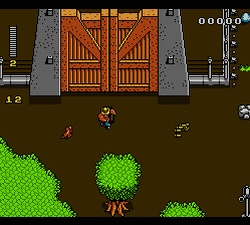
In Jurassic Park on the NES—the one everyone at home just called Jurassic Park—you’re not mashing buttons so much as wrestling with fear and adrenaline. From your first steps on Isla Nublar you lock into that retro-action cadence: a step, a rustle in the brush, a quick chirp on the radar, and something toothy bursts out of the shrubs. The camera stays overhead and the pacing is tight, proper top-down adventure energy: you’re always on the move, scanning paths, catching the blink of egg and medkit icons, threading your way through electrified gates. In your head it’s not stats or math, just a blunt little mantra: “Make it. Grab everything. Stay alive.”
The island’s tempo: run, collect, a nervous undertone
Every zone is a bite-size story about “gather the eggs and get out.” You pop open the map, sketch a route, and check the radar that stubbornly pulls you toward nests. The eggs aren’t lined up: one’s tucked by a paddock, another in a tight yard between containers, another right in a corridor where you can hear claws clicking. Locked doors show up—you hunt down access cards and terminals, power up generators to bring sections online and squeeze past electric fences. All the while you chase the rhythm: rush too hard and you’ll eat a two-raptor ambush; slow down and dinos start respawning with such persistence you’ll burn through your last bullets.
There’s no giant countdown plastered on the screen, but a timer lives in the details: short musical loops, the chime of a collected egg, the hiss in the leaves that spurs you on better than any alarm. And when there’s just one egg left, you can almost hear an invisible metronome ticking nearby—you know one wrong detour, and the enemy loop snaps shut.
Clashes: raptors—lightning, dilophosaurs—venom, T. rex—fear
Gunplay here isn’t cowboy bravado; it’s discipline. Ammo is gold: for small fry—tranq shots; for crowds—something heavier when you snag grenades; in danger zones you count every trigger pull. Velociraptors win on speed: lunge, leap, and if you don’t back off in time they paint your screen red. Dilophosaurs spit, wrecking your aim and sealing escape lanes; get caught in their spray and you slog for a couple seconds like through syrup. Compies nag like mosquitoes—not lethal, but they scramble your focus, especially with real predators on your tail. Pteranodons love to dive-bomb the open: look up and you’re already eating a hit from above; you learn to hug walls to shrink their attack angle.
And of course, the T. rex. Childhood memory made flesh—he doesn’t punch a timecard, he arrives with thunder and a roar that makes you want to melt into the pixels. Nobody grandstands: see the screen shake, and you find a fence, take a corner, reroute. He’s not a “boss” in the usual sense; he’s the threat of Isla Nublar itself, reminding you you’re a guest with a flimsy plan and a thin health bar.
Routes and labyrinths
Outside it’s jungle, footpaths, paddocks, tidy platforms that look safe—until they aren’t. Step inside a building and the tempo changes: narrow corridors, 90-degree turns, terminal rooms with pop-up instructions, storage where the access cards hide. No bloat—short, crisp “missions,” each its own compact maze. Indoors the tension grips tighter: the passage narrows, footsteps get heavy, and any little pocket can be a trap with a pair of raptors already waiting. Take a wrong turn—take a bite, but now you’ve learned the layout. Try after try, a personal map blooms in your head.
There’s that special retro-adventure buzz when one egg is stashed “where it shouldn’t be,” and you’re laying down breadcrumbs on the fly—“if the generator was on the left, then on the right, past the door with the yellow stripe, there’s probably a nest.” Sometimes the game trolls you—spins you in a circle back to a familiar junction—and you grin: alright, Jurassic, got it, I’ll take another path. Some folks called it “Dinosaur Park” back then—and it fits here literally: the park takes your hand only to toss your heart onto another springboard.
The tiny things memory is made of
You’re always balancing “collect it all” with “make it to the exit.” Medkits sit just off your eyeline—always a step farther than feels comfy. Ammo drops are rationed, nudging you to blend precise single shots with rare “go heavy” bursts. Electric gates snap with a satisfying finality when you finally nab the right card; generators hum like a promise of progress. The game doesn’t preach who you are or why—it’s enough to know you’re Dr. Alan Grant, and ahead waits another zone, another clutch of eggs, another round of “cut the power—restore the power—fall into a new story.”
This Jurassic Park doesn’t flex scale; it owns the moment-to-moment. One run you’re sprinting almost nonstop, kiting raptors down straightaways; another you’re crouched in bushes, parsing every beep because your health is a sliver. That’s what lights up your fingers: every step a choice, every egg a small win, every opened door a breath. By the end you feel less like a player and more like a tour guide on a route you carved through grass, concrete, and live wire—where the sign at the exit reads the familiar “Jurassic Park,” and somehow it sounds warmer than any other name.